


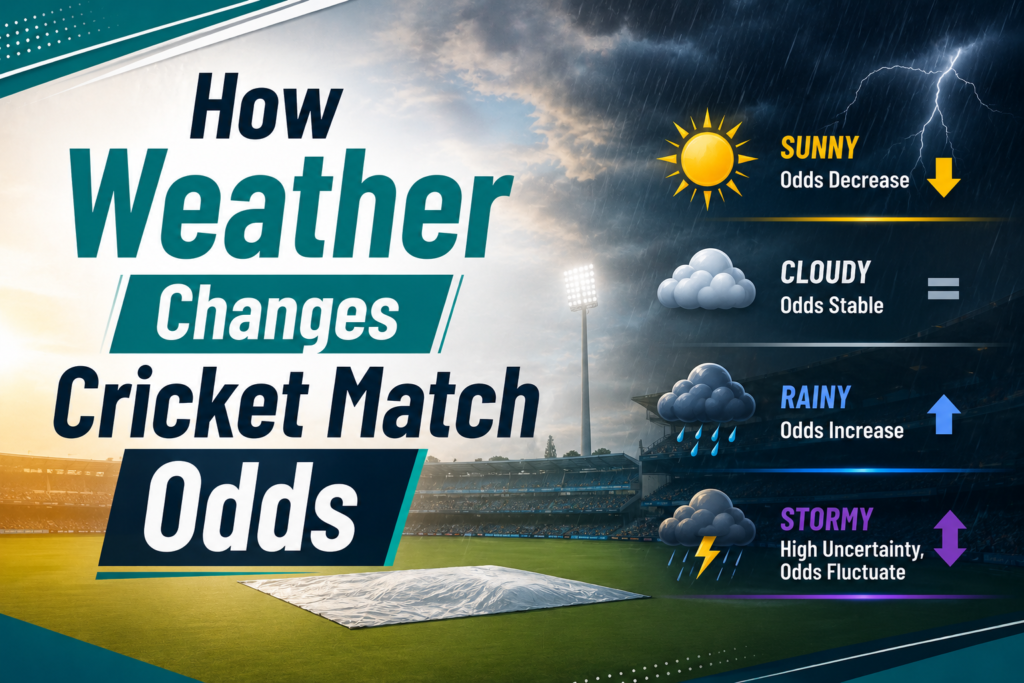
Weather is one of the easiest factors to overlook when analyzing a cricket match, yet it can influence almost every part of the game. For readers searching for tigerexch today information, understanding how weather affects match conditions can provide useful context for interpreting changing cricket markets. Rain, humidity, wind, temperature, cloud cover, and dew can all influence batting, bowling, fielding, and even the expected number of overs.
The effect is rarely as simple as “rain favors one team.” Weather interacts with the pitch, venue, playing conditions, team selection, and match format. A cloudy morning may help swing bowlers in one location, while high humidity and evening dew may affect spin and fielding in another.
That is why weather should be considered alongside current team form, playing XI announcements, venue statistics, and match conditions rather than treated as an isolated prediction factor.
Tigerexch Today: Why Weather Can Move Cricket Odds
Cricket odds can change when new information changes expectations about a match. Weather forecasts are one source of that information.
If rain threatens a limited-overs match, the possibility of a shortened game can change how teams are expected to approach their innings. A side with aggressive power hitters may become more valuable in a reduced-overs contest, while a team built around accumulating runs gradually may face a different tactical challenge.
Similarly, strong wind can influence boundary hitting and bowling conditions. A humid evening can contribute to dew, potentially affecting the second innings.
The important point is that weather does not determine the result. It changes the conditions in which the teams have to perform.
How Rain Changes a Cricket Match
Rain is perhaps the most obvious weather factor because it can directly reduce playing time. In limited-overs cricket, interruptions can lead to fewer overs being available. When the number of deliveries decreases, the value of each wicket and scoring opportunity can increase.
A team batting first in a shortened match may need to attack much earlier than it would in a full-length innings. For example, a T20 side normally has 20 overs to build an innings. If rain reduces the match to 10 overs per side, there is far less time for traditional consolidation. This can change batting strategies significantly.
Openers may attack immediately, while bowlers may rely more heavily on variations designed to prevent boundaries.
Duckworth-Lewis-Stern and Reduced Matches
When rain interrupts a limited-overs match, target calculations can become more complicated. The Duckworth-Lewis-Stern method is used in international and many domestic limited-overs competitions to calculate revised targets when teams lose playing time.
The system considers resources such as overs and wickets rather than simply reducing the original target proportionally.
This matters because a rain-affected match can develop differently from a normal game. A team that was comfortably positioned before an interruption may face a substantially different target afterward. For anyone analyzing weather-sensitive cricket markets, understanding that possibility is important.
Humidity and Swing Bowling
Humidity is often discussed in relation to seam and swing bowling, although its actual effect is more complicated than many casual cricket explanations suggest.
The condition of the ball, atmospheric moisture, pitch, wind, and bowling technique can all contribute to movement. Cloudy conditions can also coincide with an environment in which conventional swing becomes more noticeable.
For batting teams, this can make the opening overs particularly important. Top-order players may need to spend more time judging movement before attempting aggressive shots.
Experienced swing bowlers can exploit uncertainty by attacking the outside edge or targeting the stumps.
How Tigerexch Today Weather Information Should Be Read
Weather information should be interpreted alongside the cricket venue rather than viewed on its own. A forecast predicting rain does not necessarily mean the match will be washed out. The timing matters.
Rain expected before the match may affect the pitch without necessarily reducing the number of overs. Rain predicted during the middle of the game presents a different situation.
Likewise, a forecast for high humidity does not automatically mean significant dew will appear.
When reviewing weather information, consider:
- Expected start-time conditions
- Rain probability and timing
- Temperature
- Humidity
- Wind direction and speed
- Cloud cover
- Dew potential
- Ground drainage
- Historical venue behavior
This provides a more realistic picture than focusing on one weather statistic.
Dew and the Second Innings
Dew can become especially relevant during evening limited-overs matches. When moisture settles on the field and ball, fielders may find handling the ball more difficult. Bowlers, particularly spinners, may also experience reduced grip.
That can influence the second innings. A captain choosing whether to bat or field after winning the toss may consider the possibility of worsening conditions later in the evening.
However, dew is not guaranteed. Its presence depends on temperature, humidity, wind, surface conditions, and local environment. Some grounds experience substantial dew, while others see little meaningful effect.
Wind and Boundary Hitting
Wind can have a direct tactical effect on cricket. A strong crosswind can influence the flight of the ball, while a tailwind or headwind can affect the distance achieved by aerial shots.
Batters may deliberately target one side of the ground depending on wind direction. Captains can also adjust field placements.
A fielder positioned near the boundary may be placed on the side where the wind is helping the ball travel farther. Bowlers can use the wind when deciding their angle of attack.
These details become particularly important in T20 cricket, where boundary-hitting is central to scoring strategy.
Temperature and Player Performance
Extreme temperatures can affect players physically. Very hot conditions can increase fatigue, particularly during long innings or extended spells in the field.
High temperatures may also affect hydration requirements and concentration. In contrast, cooler conditions can create a different playing environment.
The impact is not always visible in the scoreboard, but fitness and concentration can influence fielding quality, running between wickets, and bowling accuracy. This is one reason professional teams place significant emphasis on preparation for local climate conditions.
Cloud Cover and Bowling Conditions
Cloud cover is often associated with favorable conditions for seam bowling. However, cloud itself does not guarantee movement.
The ball’s condition, pitch, atmospheric conditions, bowling skill, and wind all contribute. A team facing a strong seam attack under overcast conditions may therefore approach the opening overs more cautiously. If the weather clears and batting becomes easier later, the match can develop into a completely different contest.
Weather and Pitch Behavior
Weather can influence the pitch before and during a match. Heavy rain followed by sunshine can produce changing surface conditions. A damp outfield can also affect fielding and ball speed.
Ground staff work to minimize these effects through drainage and pitch preparation, but weather remains an important variable.
Some pitches dry quickly and return to normal conditions soon after rain. Others may retain moisture for longer. The venue therefore matters as much as the forecast.
Weather Effects by Cricket Format
Different formats respond differently to weather.
T20 Cricket
T20 matches have limited time, so interruptions can have a major impact. A shortened game often increases the importance of attacking batting and efficient bowling.
ODI Cricket
ODIs have more overs available, but significant rain can still change targets and tactics. The revised-innings calculation can transform the strategic value of wickets and scoring rates.
Test Cricket
Weather can have an even larger impact over several days. Rain can remove entire sessions, affect declarations, and reduce the time available to take 20 wickets.
A forecast of persistent rain may therefore influence tactical decisions long before the final day.
Why Forecast Accuracy Matters
Not every forecast should be treated as equally reliable. Weather models can change as new observations become available. A forecast several days before a match may be less certain than one issued shortly before play.
This is especially relevant for rain because a small change in the timing of a shower can determine whether an innings is interrupted. For cricket analysis, it is therefore sensible to distinguish between a possibility and a confirmed weather event.
Weather Can Change Team Selection
Conditions can influence playing XI decisions. A team expecting a seam-friendly surface may select additional fast bowlers. If the pitch is expected to turn, captains may prefer specialist spinners.
Hot conditions can also influence decisions around player workload and bowling combinations.
The announced lineup can consequently provide additional clues about how teams expect the conditions to behave.
Why Weather Alone Is Not Enough
A common analytical mistake is assigning too much importance to one weather factor.
For example, saying “there is dew, so the chasing team will win” ignores batting quality, bowling strength, pitch behavior, and the target.
Similarly, assuming that cloud cover guarantees swing overlooks the quality of the bowling attack and the condition of the ball.
Weather should be treated as one part of a larger evidence set. Strong cricket analysis combines environmental information with actual team and match data.
A Practical Weather Checklist
Before analyzing a weather-sensitive cricket match, check the forecast and then connect it to the venue. Look at the expected temperature and humidity.
Check whether rain is likely before or during play. Consider wind direction. Find out whether the venue traditionally experiences evening dew.
Review the expected pitch characteristics. Then compare those conditions with the strengths of both teams. This approach provides considerably more useful information than simply checking whether an umbrella icon appears in a weather app.
Responsible Interpretation of Cricket Markets
Weather-related market movement should not be interpreted as a guaranteed prediction. A forecast can change, rain can miss the ground, and players can perform differently from expectations.
Anyone viewing sports markets should understand that uncertainty remains even when several factors appear to favor one outcome.
If a service includes regulated wagering, users should also check the applicable laws, age requirements, licensing information, and responsible-use policies in their jurisdiction.
Conclusion
Weather can influence cricket in subtle and dramatic ways. Rain can shorten matches. Humidity and cloud cover can affect bowling conditions. Wind can change boundary strategies. Dew can influence the second innings. Extreme temperatures can affect player workload and concentration.
For readers following tigerexch today information, the most useful approach is to connect weather data with the actual cricket environment. The forecast should be considered alongside venue history, pitch behavior, team selection, player strengths, and the format being played.
Tigerexch today should therefore not be viewed simply as a source of changing numbers. Understanding the cricket behind those changes is what makes weather-related analysis more meaningful.
Ultimately, no forecast can remove uncertainty from cricket. Weather is one variable within a much larger sporting equation, and its significance depends on when, where, and how it affects the match.
Frequently Asked Questions
Can rain change cricket odds?
Yes. The possibility of rain can influence expectations because an interruption may reduce the number of overs or lead to a revised target. The effect depends on the timing and severity of the interruption.
Does humidity help swing bowlers?
Humidity may be associated with conditions that support swing, but it is not the only factor. Ball condition, wind, pitch characteristics, cloud cover, and bowling technique also matter.
Why does dew matter in night cricket?
Dew can make the ball wet, potentially making it harder for bowlers to grip and fielders to handle. Its effect varies considerably between venues and weather conditions.
Does cloudy weather always favor bowlers?
No. Cloud cover can coincide with conditions favorable to seam movement, but it does not guarantee that bowlers will dominate. Pitch, ball condition, wind, and bowling quality remain important.
How does wind affect cricket?
Wind can influence ball flight and boundary hitting. Batters may target the shorter or more favorable side of the ground, while bowlers can adjust their angles and delivery plans.
Why can weather affect T20 matches so quickly?
T20 matches contain only 20 overs per side, so losing even several overs can significantly change scoring strategies and revised targets.
Should weather be the main factor when analyzing a cricket match?
No. Weather is only one factor. Team quality, playing XI, pitch, venue, current form, batting depth, bowling resources, and match situation should also be considered.